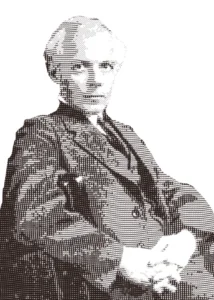
Béla Bartók
I owe it to Béla Bartók that I became a musician at all. I went to a grammar school that specialised in mathematics and physics, but in Year 3 I took part in a music-knowledge competition where we got to learn about Bartók from the greatest experts, László Somfai among them. Béla Bartók’s art struck me like a bolt of lightning, and that moment still shapes my career and my way of thinking today. Bartók was one of the discoverers of Hungarian folklore. He folds folk music into his musical thinking in a way all his own. In his early works we hear folk songs; later, folk-like melodies; and later still, it seems we hear neither folk songs nor folk-like elements at all. Yet listen closely and it is astonishing how a folk-song quality can be found in every single one of Bartók’s gestures!
By uncovering authentic Hungarian folk music and raising it to the level of modern concert music, he gave our cultural identity a wholly new perspective. We can see clearly now that he cut a path through the labyrinth of twentieth-century musical styles that will surely last into the twenty-first—indeed, for as long as people make music and there are others to listen. We must also recognise, though, that Bartók’s music reflects not only Hungarian folk music but that of the neighbouring countries too: Romanian, Slovak, southern Hungarian, and even certain Ukrainian elements. All of these are defining features of the composer’s entire body of work. Before we set about interpreting Bartók’s works, I’d like to point you to the four defining intonations of his output. ‘Intonation’ here is an aesthetic term; it has nothing to do with the quality or the tuning of a sounding note.
One of the central questions of aesthetics is the idea of beauty, which has many definitions and can be regarded as a kind of intonation within the logic of many a body of work. Beauty, as an intonation, may be set against the non-beautiful or the ugly. In sacred works we often find the divine and the earthly voiced as opposing intonations. Intonation is, in essence, the artist’s way of taking possession of the world and expressing it in his own individual manner. Mozart, too, is a composer best approached through the characteristic intonations of his output. We identify Mozart’s intonations with his most important operatic heroes, each of whom embodies a particular emotion or idea. We can even find these figures in his purely instrumental works—in a piano concerto or a symphony. With Bartók, too, the moods largely come from his stage works.
In his case, though, we tie them not to the characters who appear in the works but to the emotions and characters bound up with them. One such intonation is the night. A key idea of Bluebeard is embodied in the image of the lake of tears. This image returns in almost all of Bartók’s works—though later as an image of nature at night—and is nearly always accompanied by an expression of human loneliness. The second is the grotesque. This idea is tied to The Wooden Prince, which holds both an odd, strange humour and one of humanity’s most important twentieth-century questions: the danger of the copy becoming self-aware. The comedy of the grotesque turns up in Bartók’s most dramatic works as well, for even in the depths of his greatest pain a person can still manage a smile, a laugh. But we can also recognise it in the passage of the piano piece A Bit Tipsy, which conjures a drunken air.
At the same time, we often meet the terrifying side of the grotesque in his output—whether in the Four Orchestral Pieces or in the Concerto—where some small triviality suddenly turns into brutality. The barbaric musical character of The Miraculous Mandarin is the third key idea in Bartók’s output. It, too, has many faces, whether in the wild piano piece Allegro barbaro or in the mechanical, at times menacing clatter of the works written around 1926. But we might also point to that moment in the Concerto just mentioned, where an idea seems to throw off its mask and stand behind us as its own evil opposite. All three of these ideas can be detected across a great many of Bartók’s compositions. As for the use of intonations, the philosophy of Goethe’s Faust shows through in all three of Bartók’s stage works: Faust and Mephistopheles are both us, just as night and day live within us.
Bluebeard is at once the night of the beginning and the end, and, at the climax of the piece, the blinding light of power. The Wooden Prince mirrors the schizophrenic mix of our indifference and our enthusiasm in equal measure, while The Mandarin probes the central question of modern civilisation, in which we brand those unlike us barbarians, while our own barbarism blinds us to the human worth in the other. The inner contradictions among the three ideas and intonations listed so far give rise to the fourth, the ars poetica-like intonation of Bartók’s output: the idea of peoples becoming brothers. For Bartók this is the idea of humanity, love and tolerance, which he sets down in his so-called folk-dance finales. The message of Beethoven’s Ninth is easy to recognise in it. Like Beethoven’s universal, unifying intent and cosmic longing, Bartók’s idea, too, is unattainable.
Seen from another angle, however, the intent of both is incredibly rational and unquestionably true. Here in Eastern Europe—thanks to slower urbanisation and a long history under foreign rule—we have more or less managed to hold on to our thousand-year-old culture, so that by comparing the musical traditions of neighbouring nations we can still see what a pity it is to make war or to nurse hatred, since we have far more in common than we have apart. Allow me a little musical chauvinism: our music and our dances are the two most basic non-verbal expressions of our culture, and its truest reflection. The lay Hungarian and Romanian listener can be fooled by each other’s music; each readily takes it for his own alone—not to mention that folk music was mostly played by Roma, so that it became automatically bound up with a kind of Roma tradition.
But I could just as well mention my experiences in Israel: at the end of a concert we gave with Israeli Jewish and Arab musicians, all I could say was that there is absolutely no sense in fighting—your music is the same. Experts and laypeople alike can spot differences, but take a step back and the differences fade behind the similarities. This is exactly what Bartók recognised, having travelled through countries rich in ancient folklore, from Upper Hungary all the way to Bessarabia. Another key element in Bartók’s works that helps us find our bearings is structure. From European musical culture we have inherited the four-movement layout, which can be traced through all the classical cyclical forms, the symphony included, right up to the turn of the century.
Bartók uses it in several works, yet he also creates a distinctly his own, ‘Bartókian’ form: the so-called bridge form, which runs to five movements. Its hallmark is that the dramatic process, the musical narrative and the heart of the composer’s message are carried by the first, third and fifth movements, while the movements in between—the second and fourth—act as a counterweight, offering respite, occasionally halting the process, and, seasoned with playfulness, slotting in as interludes among the elements that carry the serious message. From a dramaturgical point of view, the centre of Bartók’s bridge forms can be either the emotional low point or the climax of the process. The outer movements, too, may echo each other, presenting the same state of mind or musical idea, or the final movement may be the exalted culmination of a struggle-filled beginning.
Béla Bartók: Bluebeard’s Castle
The Gates of the Soul
Start
Béla Bartók: The Wooden Prince
Do Not Make Yourself a Carved Image!
Start
Béla Bartók: The Miraculous Mandarin – Suite
Barbarism and Civilisation
Start
Béla Bartók: Cantata profana
The Source of Purification
Start
Béla Bartók: Music for Strings, Percussion and Celesta
Macrocosmos
Start
Béla Bartók: Divertimento
Music or Entertainment
Start
Béla Bartók: Concerto
A Summary of a Life’s Work
Start
Béla Bartók: Piano Concerto No. 3
Morning Music
Start