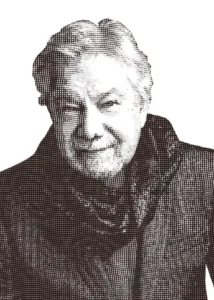
László Dubrovay
The piano is one of the defining instruments of László Dubrovay’s life. He has composed countless works, and a prominent part of his output consists of three piano concertos. Dubrovay’s music is marked by inexhaustible invention and an extraordinary openness to innovation. Throughout his career he has tried his hand at almost everything: at first, under the influence of the avant-garde, he wrote dodecaphonic works; he then experimented with electronics and many new instrumental techniques, and his musical language was also shaped by numerous new playing techniques, new timbres and new compositional methods. At the same time, Bartók’s positional technique, based on a broader reading of the overtone system, has had a significant influence on his way of thinking. Dubrovay is also a composer who believes in the overtone system. He perhaps uses even more overtones than Bartók.
It is worth noting, though, that these multiplied overtones may in some cases sound dissonant; yet we do not perceive this as dissonance, but rather as a new, interesting timbre, and these harmonies, despite the dissonances they contain, recognisably function as tension or resolution. Dubrovay constructs a distinctive tonal system in the traditional sense, in which even the more distant notes of the overtone series become part of his harmonic world. His works embody both intellectualism and expressiveness. Among the representatives of the avant-garde, he is one of those composers who knows exactly what he wants to hear. If you have the inclination and the courage, do listen to the orchestra’s recording of our composer’s three piano concertos with János Balázs! The three works give a vivid picture of this ‘back to the roots’ process. The Piano Concerto No.
1 is still a boldly experimental work with an electronic sound. Dubrovay describes the Piano Concerto No. 2 as romantic, while his latest concerto is sun-drenched, cheerful music that can be enjoyed, if you will, in the Mozartian sense, now free of all experimental and avant-garde devices, while naturally retaining the composer’s distinctive attitude and style.