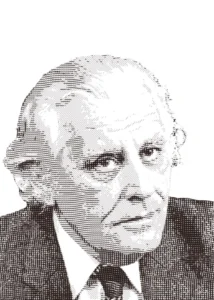
József Karai
József Karai (1927–2013)—composer, conductor and pianist—was a leading figure in choral music during the second half of the last century, though he has sadly been almost completely forgotten in recent times. He was taught at the Academy of Music by the finest teachers, including László Somogyi, who had a defining influence on my career as a conductor even before 1956. He also played an extremely important part in the life of our choir. His innovative, distinctive, modern pieces and his arrangements of folk music formed a permanent part of our repertoire, and we achieved significant success with their performances. József Karai was known to the public primarily for his protest songs and arrangements, even though the majority of his work consists of church music and folk arrangements.
Among the movement pieces is one that is memorable to my generation, Barikádra!,1 which we sing at every class reunion, because for all of us it is one of the most memorable pieces from our school-choir repertoire. I believe that for us it is not the content of these works that has remained defining, but rather the well-written, inspiring music. It was the experience of singing together that brought us joy and preserved the fond memories of these pieces within us. In his works, Karai uses modern musical devices that were absolutely unique in the choral culture of the 1980s, such as aleatoric music.2 Aleatoric music is essentially organised, group or individual improvisation. To the listener, it may seem as though the choir is doing whatever it likes, but in reality the composer gives precise instructions on the parameters within which the improvisation is to take place.
He specifies which notes the choir should use, how long the improvisation should last, whether it should be faster or slower, louder or softer, whether the parts and singers should sing together or separately, and so on. This technique is familiar primarily from the works of Witold Lutosławski,3 and offers a very logical alternative to overly notated contemporary music, which is precisely notated down to the smallest detail and has become very difficult to read and perform. In the 1940s and 1950s, composers increasingly moved away from traditional harmonic structures, and their rhythmic thinking no longer stemmed from a sense of pulse; they filled the musical space with sounds in a way that was barely interpretable rhythmically. One must imagine that the notation of the rhythm in the score became extremely complex, as composers notated even the minutest micro-rhythms.
Reading the complex notations thus produced caused performers extraordinary difficulty; so, instead of a performance style defined down to the tiniest detail, Lutosławski sought to achieve the same effect through organised improvisation. This approach can be far more appealing to the performer, since, rather than the agonising struggle to realise the complexity, it allows them to give the best possible performance of the work with considerable interpretative freedom. Karai employs this technique brilliantly. It gives the mostly amateur singers a much more active role in the realisation of the work; moreover, the performances gain a double charm: everyone feels responsible for their own part, while the rehearsal and performance process becomes extremely exciting, because the piece never sounds the same twice.
Karai’s harmonic world and his approach to tonality are unambiguously conservative; I might even call them post-Romantic. The fundamental pillar of the sound in his works is the seven-note, that is, the diatonic, scale. At the same time, he does not necessarily use all seven notes; instead of certain notes from the scale, one or another note from the chromatic scale often becomes part of the scale currently in use. Karai’s melodic world is therefore fundamentally diatonic, while at the same time it also contains chromatic elements, the consistent appearance of which becomes an indispensable means of emotional expression.