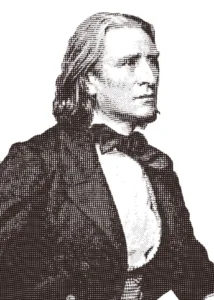
Ferenc Liszt
Ferenc Liszt’s body of work is something no young conductor can do without. I have loved Liszt since I was a boy, because his music has such tremendous force. His grand manner—the triumphant close, the glorification or the damnation, the steady gaze fixed on death—comes through clearly and is felt even by listeners with little musical training. The more deeply I came to know Liszt’s output, the more I narrowed it down to the works that mean the most to me: the Faust Symphony and the Sonata in B minor. Knowing these two is one of the keys to understanding Romantic music, and it also gives you a foothold for grasping the music of the twentieth century. Liszt was decisive, too, in establishing a Romantic-era practice: writing the artist’s self-image into the work, and drawing the listener into the act of creation.
When you stop to think about it, we know relatively little about Bach’s relationship with himself as a creator—and indeed there is barely a trace of it in his music. Mozart is the first composer about whose creative temperament we know more, but that is chiefly down to his unusual personality, which set him above the world around him. Even so, we know this not from the music but from his copious letters. It is worth weighing, too, that if we set these two giants of music history side by side and compare how each related to himself, the greatest difference lies in Mozart’s sense of his own genius—something entirely absent in Bach. Why do we know more about Mozart’s self-awareness than about Bach’s? The answer lies in the worlds they lived in.
Bach, who spent most of his life in the service of the church, had little acquaintance with applause as we understand it today: the cantatas he wrote for worship were functional music, composed to serve the liturgy, not to entertain an audience. Mozart belonged to a different age. By his time the concert in the classical sense had come into being, so he was fêted by rulers and by a middle-class public whose sway was spreading across Europe. In Bach, even the most powerful, most spellbinding moments arise purely from the logic of the music itself, whereas Mozart took great pains to dazzle his listeners as well. One thing is certain, though: for both Bach and Mozart the process and manner of composition—of creation—was still taken for granted.
Beethoven, writing a few years later, was among the first composers in whose music you can already sense the struggle that creation costs, a glimpse of its difficulties. And that, in fact, is the threshold of Romanticism. By then Franz Liszt was a composer celebrated across Europe and, first and foremost, a virtuoso pianist, wrapped in a kind of cult of genius—itself a characteristic motif of the Romantic age. As the artist steps into the foreground, the act of creation becomes the central concern of Romanticism—whether it is the difficulty of bringing a work into being or the moral questions that grow out of it, voiced now with ever greater force.
From the eighteenth century onwards, the idea spread that a creative, inventive mind can only come to terms with the world through doubt.1 The duality of faith and doubt is really one of the defining issues of nineteenth-century thought, shaded by the contradictions between the social and religious morality of the day. It is no accident that Goethe’s Faust became a central symbol of the era. Faust’s pact with the devil is symbolic: Mephistopheles, above all, points the way to knowledge and to the joy of living. The Faust theme stayed with Goethe his whole life; we know almost every stage of its making, and at its heart lies the tension between damnation and redemption. No accident, either, that this theme—and especially its moral dimension—occupied Franz Liszt so intensely.
The story of that legendary medieval figure, Doctor Faust, has been retold by many: Lenau’s2 Faust mattered to Liszt at least as much as Goethe’s. Faust is the questioning, searching, doubting mind, and so the archetype of the newly enlightened European. Lest there be any misunderstanding: creative doubt is, of course, not unique to Romanticism. It surfaces in earlier art too—sometimes unnoticed, sometimes with startling boldness. Bach’s output can fairly be called the most triumphant expression of faith there is, marked by a way of thinking wholly coherent within its own system of means. And yet I can point to plenty of doubting moments in his music. The setting of the words ‘I await the resurrection of the dead’ (Et expecto) in the Mass in B minor, for instance, turns at one point distinctly uneasy, even frightening.
Listening to that passage, you think of the apocalyptic visions of early-Renaissance painters from Germany and the Low Countries—Jan van Eyck or Bosch—where skeletons seem to climb out of their graves. We might read this fleeting musical uncertainty as doubt about the resurrection, but it could just as well be dread of the Last Judgement. In the second half of the movement, of course, Bach makes amends for this very passage with a dance of sweeping momentum. And all the while the words of András Pernye, the legendary old teacher at the Academy of Music, ring in my ears: his remark that ‘all this is typical Protestant thinking; a Catholic would never have dared do such a thing with this text’. In any case, where in Bach the expression of doubt—if only for a moment—was one creative gesture among many, in the Romantic era it became a defining motif that saturates a whole work.
Doubt, then, has been a universal part of creation for as long as art has existed. What is new and different about Romanticism is that, whereas in earlier times doubt was instinctive or hidden, by the turn of the eighteenth and nineteenth centuries it had become an openly stated idea. Liszt was one of the pioneers of this, and nowhere is it plainer than in the Sonata in B minor and the Faust Symphony. 1 René Descartes (1596–1650) developed the idea of ‘methodical doubt’ in his philosophy, which he regarded as the key to understanding the world. In this process, doubt is pushed to the very limits of cognition; only when doubt ceases can knowledge be complete. 2 Nikolaus Lenau (1802–1850) was an Austrian poet and a leading figure of German Late Romanticism. In his narrative poem Faust, Faust seeks not only knowledge but also to become God’s equal and to be free of him.
Here Mephisto is no part of the divine order, and—unlike in Goethe—he comes off victorious in the struggle with Faust. Lenau’s Faust inspired Liszt to compose the symphonic work Two Episodes from Lenau’s Faust, the second movement of which is the Mephisto Waltz.