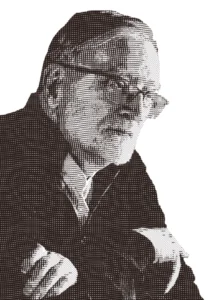
György Orbán
György Orbán is a leading composer of the turn of the twentieth and twenty-first centuries, equally at home in every genre. I first came to know him through his choral works, and these pieces have done a great deal for my choir’s success. Orbán is a composer par excellence, whose choral works offer singers all over the world not only an outstanding experience but a genuine challenge. He was a regular guest at our choral competitions; in time we began to perform his works one by one with the orchestra, and today he honours us by inviting us to do so regularly. One feature of his musical language is that he thinks in classical forms, and within them he has both a strong desire and a real gift for characterisation. He loves the device of allusion and uses it consistently, drawing readily and very deliberately on the repertoire of our shared musical memory.
In doing so he stirs emotions and sensations in the listener — though humour and the conjuring of the grotesque are no less characteristic of his work. One of the defining experiences of my life was hearing his Rorate caeli for the first time. It is a work of epoch-making significance: it lays bare essential, astonishing emotions and confronts us with ourselves, yet at the same time it transcends, with almost superhuman ease, everything that cannot be transcended, and forges for us a perfect unity; it holds a whole life within it, the universe itself. The piece reaches far beyond the Advent expectancy of the Rorate Masses — Orbán composes the very essence of existence into it. It is a work to set beside Zoltán Kodály’s Psalmus Hungaricus, with connections and kinships to be found in countless details.